
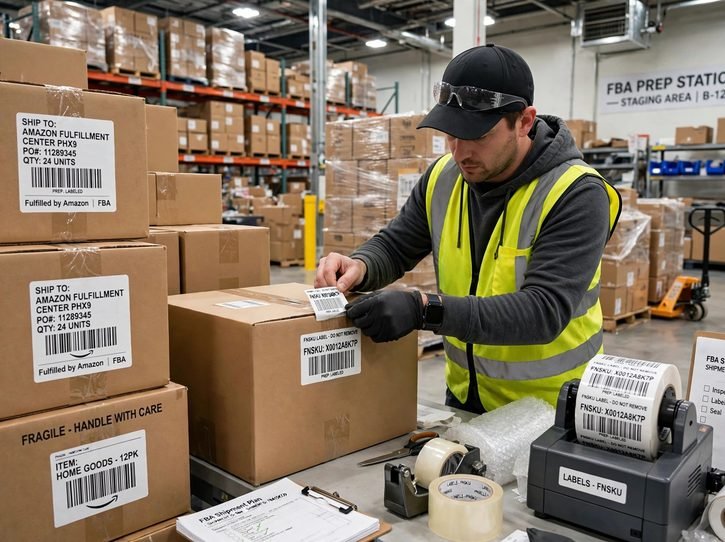
On January 1, 2026, Amazon permanently stopped offering prep and item-labeling services for US FBA shipments. Every unit you send to a fulfillment center must now arrive fully prepped: labeled, bagged, bundled, and boxed to Amazon’s spec. If you buy wholesale, the fix isn’t complicated, but it does change who does what in your supply chain. This guide walks through exactly what ended, what happens to unprepped shipments now, and the three practical ways wholesale sellers are handling prep in 2026.
What exactly ended on January 1, 2026
Amazon announced the change to sellers in mid-2025 and made it permanent at the start of 2026. It applies to all US FBA shipments, including inventory routed through Amazon Warehousing and Distribution (AWD), Amazon Global Logistics (AGL), the SEND program, and the Supply Chain Portal.
The services Amazon no longer performs:
- FNSKU barcode labeling
- Poly bagging and opaque bagging
- Bubble wrapping
- Taping and sealing
- Suffocation warning labels
- Bundle and multi-pack creation
- Set preparation
- Item inspection
- Sticker removal (covering old barcodes)
In Amazon’s own words to sellers, the vast majority of sellers now handle their own packaging, including prep and item labeling, so the company shifted the work back to sellers permanently to streamline its warehouses.
What happens if your shipment arrives unprepped
This is the part that catches people off guard. Amazon won’t fix your mistakes anymore. There is no paid safety net. Based on how the policy is being enforced in 2026:
- Rejected shipments. Entire shipments can be turned away at the fulfillment center dock if units aren’t prepped to spec.
- Disposal at your expense. Non-compliant products may be returned or disposed of, and you foot the bill.
- No reimbursement. Items lost or damaged that weren’t properly prepped are not eligible for reimbursement.
- Higher non-compliance fees. Inbound defect fees rose sharply in 2026 (industry trackers report roughly $0.32-$1.74 per standard unit, up from pennies in 2025; verify current figures in Seller Central before quoting them to anyone).
For wholesale sellers the risk is concentrated in one place: the handoff between your distributor and Amazon. That handoff used to have Amazon’s prep desk as a backstop. Now it doesn’t.
The wholesale seller’s new flow: distributor → prep → FBA
Private-label sellers felt this change as “find a prep center.” Wholesale sellers have a slightly different, and arguably better, set of options, because the product already exists in a distributor’s warehouse before it ever touches Amazon.
Here’s how the flow works now:
- You place your wholesale order with your distributor, as before.
- Prep happens before the FBA shipment is created, either by the distributor (if they offer FBA prep), by you, or by a third-party prep center that receives the distributor’s shipment first.
- The FBA shipment is created in Seller Central with correct case quantities and box content labels.
- Prepped, labeled cartons ship to the assigned fulfillment center(s).
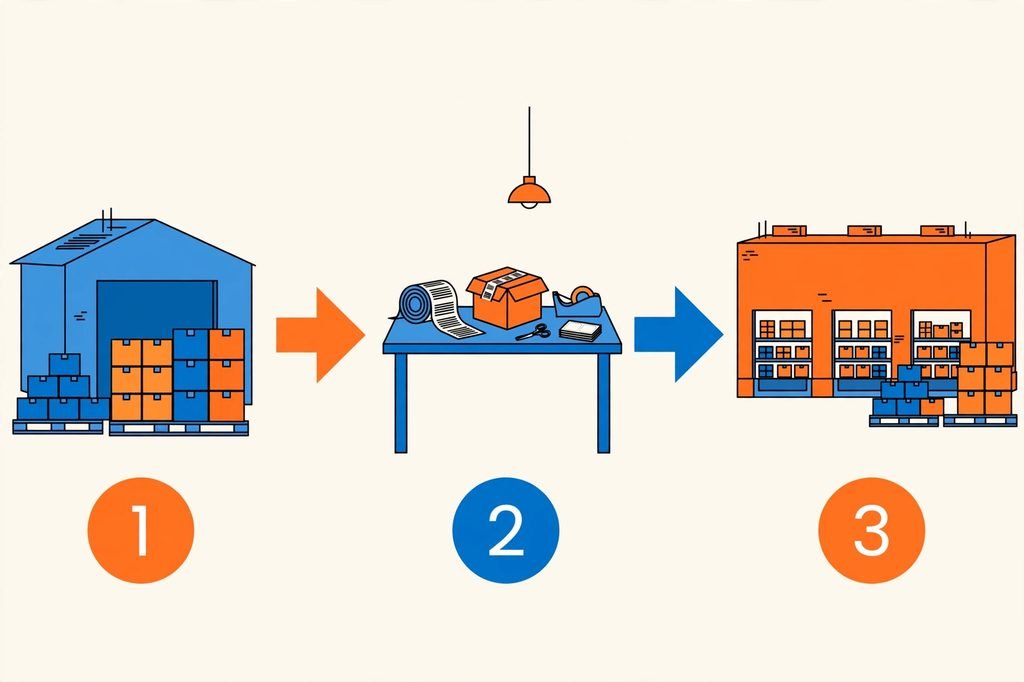
The key shift: prep moved upstream. The cheapest place to fix a labeling problem is at the distributor’s dock, not after a rejected truck shows up in Ohio.
Your three options, honestly compared
Option 1: Prep it yourself. Makes sense if your monthly volume is small and the products are simple (single units, no bundling). You’ll need a thermal label printer, the right poly bags, and a checklist you actually follow. The hidden cost is your time, and the occasional rejected shipment while you learn. Most sellers outgrow this faster than they expect.
Option 2: Have your distributor ship direct to FBA, prepped. This is the cleanest option when it’s available. Some wholesale suppliers now offer FBA-ready fulfillment: they pick, prep, label, case-pack, and ship straight to Amazon’s warehouses from their own dock. One handoff instead of two, no middleman warehouse, no double freight. If your supplier offers it, ask what’s included: “we ship to Amazon” and “we ship FBA-compliant to Amazon” are very different promises. (This is exactly how we fulfill wholesale orders at SupplyCore USA: sourcing, prep, and direct-to-FBA shipping from one place.)
Option 3: Use a third-party prep center. The right call when you buy from multiple distributors, need kitting or bundling, or want someone to handle returns and relabeling. Published per-unit pricing in the market runs from around $0.40/unit at large prep operations to roughly $0.70-$1.50/unit at smaller centers, with extras (kitting, bubble wrap, carton repacking) billed separately. Don’t choose on unit price alone. A cheap prep center with a high defect rate will cost you more in rejected shipments than you save.
The 2026 FBA prep checklist for wholesale shipments
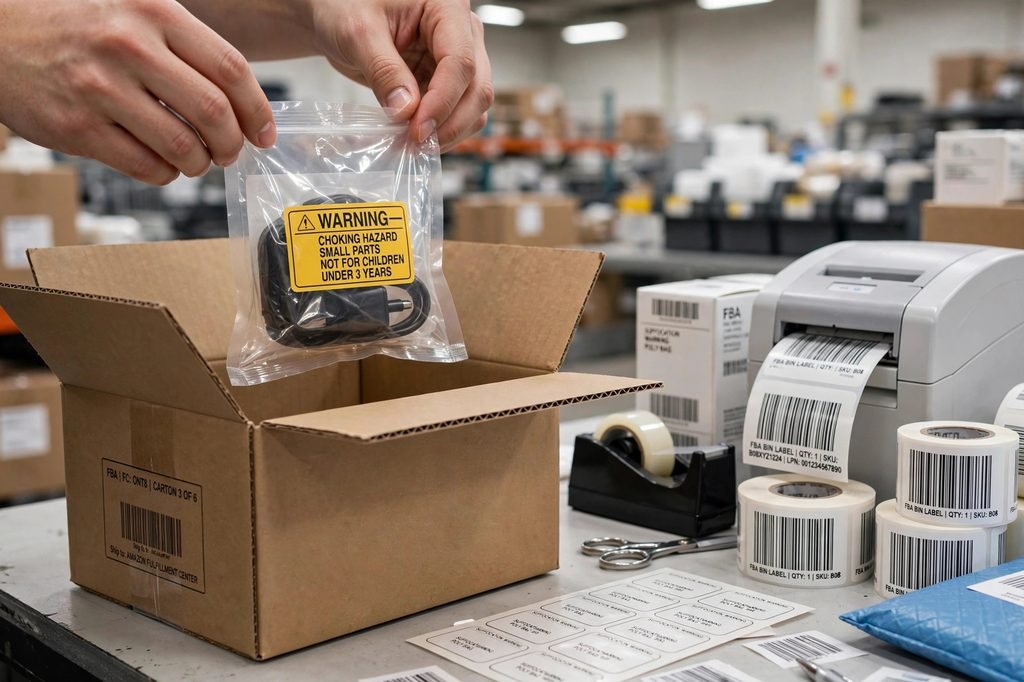
Pin this to the wall wherever your shipments get packed. Every item below reflects Amazon’s current requirements:
- FNSKU label on every unit. Each sellable unit needs its own scannable FNSKU, placed flat, not on a seam or edge. Cover or remove the manufacturer’s UPC unless you’re Brand Registered and exempt for that ASIN.
- Poly bags: 1.5 mil minimum, sealed. Any item that needs bagging goes in a clear bag at least 1.5 mil thick, fully sealed (tape, adhesive strip, or heat seal, not folded over).
- Suffocation warning at 5″+ openings. If the bag opening measures 5 inches or more, it needs the suffocation warning printed on the bag or applied as a label. The barcode must remain scannable through the bag.
- Bundles and sets fully assembled. Multi-packs must be taped, shrink-wrapped, or banded into one sellable unit before they ship. No loose components.
- The 3-foot drop test. Every unit should survive being dropped on its base, top, and corners without breaking open. Liquids and fragile goods need bubble wrap secured with tape.
- Expiry dates formatted correctly. Grocery and consumables need legible expiration dates in Amazon’s accepted format. This is a top rejection reason for wholesale grocery shipments. Grocery is also a gated category: if you plan to sell it, keep your distributor invoices organized, since Amazon requires them as proof of sourcing when you apply for category approval.
- Box content labels on every carton. Each master carton needs its label showing SKU, quantity, and FNSKU. Keep case quantities consistent within a shipment and registered in Seller Central first.
How to vet a prep partner (5 questions that matter)
Whether it’s your distributor or a standalone prep center, ask these before you commit inventory:
- What’s your Amazon shipment defect/rejection rate? Anyone doing this seriously tracks it. Vague answers are a red flag.
- Do you photo-verify before dispatch? A quick photo QC of labeled, packed cartons catches most problems while they’re still fixable.
- How do you handle FNSKU changes mid-shipment? Amazon occasionally reassigns labels. Your partner needs a process, not a shrug.
- What’s the real turnaround time? Not the marketing number, the actual dock-to-carrier time during Q4.
- Can I talk to two FBA sellers you prep for? References from actual Amazon sellers beat any sales page.
Frequently asked questions
Did Amazon really end FBA prep permanently?
Yes. Amazon announced it in July 2025 and discontinued all US FBA prep and item-labeling services on January 1, 2026. Canada followed on July 1, 2026. The company has described the change as permanent.
I only ship a few dozen units a month. Do I need a prep center?
Probably not yet. At low volume with simple products, prepping yourself with a thermal printer and the checklist above is usually cheaper. Revisit the decision when you’re spending more time labeling than sourcing. That’s the real crossover point.
Can my wholesale supplier ship directly to Amazon FBA?
Yes, and for wholesale sellers this is often the best option. A supplier that offers FBA-ready fulfillment preps, labels, and ships your order straight to Amazon’s warehouses, skipping the extra warehouse stop. Just confirm they prep to Amazon’s current spec, not just “ship to Amazon.”
What happens to inventory that arrives at Amazon unprepped?
Amazon can reject the shipment at receiving, return or dispose of non-compliant units at your expense, and charge inbound defect fees. Unprepped items that are lost or damaged are not eligible for reimbursement.
Do I still need FNSKU labels if my product already has a manufacturer barcode?
In most cases, yes. Every unit needs its Amazon FNSKU unless you’re the brand owner with the right Brand Registry role for that ASIN. Don’t assume a UPC exempts you; check the ASIN’s requirements in Seller Central.
How much does third-party FBA prep cost in 2026?
Reported market rates run from about $0.40 per unit at large prep operations to roughly $0.70-$1.50 at smaller centers, before add-ons like kitting or carton repacking. Get an all-in quote for your actual product mix rather than comparing headline per-unit rates. Before you commit, run the numbers through our free Amazon FBA calculator to see how prep fees affect your per-unit profit.
Selling wholesale on Amazon and don’t want to think about prep at all? SupplyCore USA sources authentic wholesale inventory and ships it FBA-ready: labeled, prepped, and sent directly to Amazon’s warehouses. Get a free consultation to talk through your catalog and shipment plan.