
Finding a supplier feels like the hard part of wholesale selling on Amazon. It isn’t, really. Once you’ve got Amazon FBA wholesale suppliers and distributors lined up, you still have to verify them, price the product correctly, and confirm Amazon will actually let you list it. Skip any of that, and a “great deal” turns into locked inventory pretty fast.
What Is Amazon FBA Wholesale?
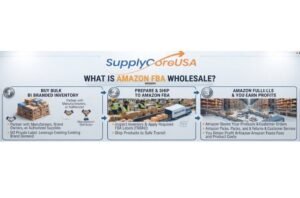
Wholesale means buying branded products in bulk from a manufacturer, brand owner, distributor, or authorized supplier, then reselling them through Amazon’s fulfillment network. It’s not a private label. You’re not building a brand from nothing; you’re stepping into demand that already exists. In theory, the flow is simple: you buy inventory, prep it for FBA, Amazon stores, and ships it, and you keep whatever’s left after fees.
Authorization is worth flagging early because it trips up a lot of new sellers. A supplier who can show an invoice or an authorization letter tying them to the brand isn’t automatically Amazon-approved. But they’re a much safer bet than one who can’t produce anything. Traceable sourcing is basically the line between a supplier and a liability.
What Types of Wholesale Suppliers Can Amazon Sellers Use It?
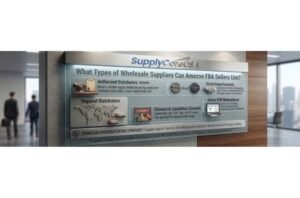
Amazon FBA sellers can source from authorized distributors, direct brand accounts, regional distributors, online B2B marketplaces, or closeout and liquidation channels. Each type carries a different balance of price, minimum order size, and supply-chain risk.
Not every supplier type fits every seller. A seller with limited capital might start with a regional distributor’s lower MOQ, while a seller chasing exclusive pricing might pursue a direct brand-supplier relationship instead, accepting the higher order minimum that usually comes with it.
Your best sourcing mix usually blends two or three supplier types rather than relying on one. That diversification protects you if a single wholesale account runs into stock shortages, while still giving you access to the wider catalog that comes from working with multiple wholesale manufacturers at once.
Authorized Wholesale Distributors
Authorized wholesale distributors give sellers access to multiple brands under one account with established ordering processes. Catalogs tend to be broader, but competition and MOQs are often higher than with smaller regional suppliers.
Working with authorized wholesale distributors means one account can unlock dozens of brands at once, which simplifies your wholesale catalog management considerably. The tradeoff is that popular products in that catalog often face heavier seller competition, so margin research becomes more important before you place a large order.
Direct Brand and Manufacturer Suppliers
Buying directly from a brand or manufacturer typically unlocks stronger pricing and exclusivity, but usually requires a higher minimum order quantity and a formal approval process. Brand-direct sourcing rewards patience over speed.
A direct account with a manufacturer often means better wholesale pricing than you’d get through a middleman distributor, plus occasional access to exclusive products not sold elsewhere. Expect a stricter application process, though, since brands vet direct brand suppliers more carefully than they vet general wholesale accounts.
Regional Wholesale Distributors
Regional distributors are worth a look if fast, domestic shipping matters more to you than the rock-bottom price. They may offer shorter transit times and simpler fulfillment logistics, even when their unit prices aren’t the lowest available.
A regional warehouse located closer to your fulfillment center cuts transit time and freight cost significantly. Domestic sourcing through USA wholesale distributors also simplifies compliance paperwork, and a niche distributor focused on a specific category can offer products a national distributor simply doesn’t carry.
Online Wholesale Marketplaces
Online wholesale marketplaces let sellers browse verified supplier catalogs and compare bulk pricing from one dashboard. They function as a discovery layer rather than a guarantee that every listed supplier is fully vetted.
A supplier marketplace speeds up comparison shopping by putting multiple wholesale catalog listings side by side, which is useful early in your search. Still treat every one of these verified suppliers as a starting point for your own due diligence, not as a substitute for checking documentation yourself.
Closeout and Liquidation Suppliers
Closeout and liquidation suppliers offer discounted excess or discontinued inventory, but supply is inconsistent and inventory risk is higher. This channel works better as an occasional supplement than a core sourcing strategy.
Excess inventory and discontinued products from liquidation channels can produce strong margins occasionally, but inconsistent supply makes this a poor foundation for a repeatable business. Treat clearance inventory purchases as opportunistic extras rather than something you build a long-term catalog strategy around.
What Is the Difference Between a Wholesale Supplier, Distributor, and Manufacturer?
People use these words interchangeably. They shouldn’t, because each one sits at a different point in the supply chain, and that affects both price and access.
A manufacturer actually makes the product and usually offers the lowest per-unit cost, though often only at high order quantities. The brand owner holds the IP and can grant a direct relationship, sometimes cutting distributors out entirely. A distributor buys from brands and resells to businesses, typically offering a wider catalog but less room for price negotiation. A wholesale supplier sits closest to you, often pulling from several of the above, trading the deepest discount for convenience.
Which one you want depends on where you’re starting from. Small budget, low tolerance for a big MOQ? A wholesale supplier or regional distributor may be more practical when you have a smaller budget or lower MOQ tolerance. Chasing a category at real scale, where margin matters more than speed? Going direct to a manufacturer or brand owner pays off, even with a slower approval process.
Where to Find Amazon FBA Wholesale Suppliers and Distributors
Most sellers try one sourcing method, get a couple of rejections, and give up too early. Real supplier lists get built from several channels running at once, not one lucky find.
Search Directly Through Brand Websites
Search “[Brand like Supply Core USA] wholesale” or “[Supply Core USA] become a retailer.” A surprising number of brands publish a dealer application right on their own site, sometimes buried in the footer where nobody thinks to look. If nothing turns up, just email the brand and ask who their authorized distributors are. Plenty will tell you, even if they won’t sell to you directly.
Use Online Wholesale and Business Directories
These save real time when you’re sourcing in an unfamiliar category, since they list manufacturer and distributor contacts in one place. Treat every listing as a lead worth investigating, not a verified supplier. Cross-check registration and contact details on your own before you order anything.
Find Suppliers at Trade Shows
Works for the same reason a phone call beats an email. You can ask a manufacturer point-blank whether they work with Amazon sellers and walk away with samples and a real contact. Research the exhibitor list beforehand, bring business information, and actually follow up within a week while the conversation’s still fresh.
Contact Brands and Distributors Directly
Direct outreach can be an effective way to turn supplier leads into actual wholesale accounts. A short, specific email beats a template every time:
“We’re an Amazon FBA seller interested in a wholesale account for [product line] could you share your MOQ, wholesale pricing, and payment terms?”
Be honest about your category focus and expected volume. Vague or inflated inquiries tend to just get ignored.
Use Reverse Sourcing
Pick a product that’s already selling well, trace it back to its brand, then to its manufacturer or distributor, and open an account from there. Starting from something you know performs cuts out a lot of the guesswork of cold-searching an entire category from zero.
Research Competitor Products and Brands
Studying which brands are moving units in your target category helps you build a shortlist worth calling. A competitor’s exact supplier connections usually stay private, so use this for direction rather than expecting it to hand you their account.
Explore Online Wholesale Marketplaces
B2B marketplaces list bulk pricing and MOQ side by side, which speeds up your first comparison pass considerably. Filter by MOQ early so you’re not wasting time on suppliers whose minimum order doesn’t fit your budget.
Sourcing isn’t something you finish. Even sellers with several solid suppliers already in place keep researching new brands, because pricing shifts and supply hiccups make a static supplier list a real risk over time.
What Do Wholesale Suppliers Expect From Amazon Sellers?
Suppliers vet buyers roughly the way lenders vet borrowers. Before you reach out, have your paperwork ready: a registered business (an LLC or corporation with an EIN), a resale certificate if your state requires one, and an active Seller Central account you can actually point to. A professional email address and a basic business website help too, more than people expect.
None of this guarantees approval. But showing up unprepared is one of the fastest ways to get ignored, and suppliers mostly just want proof you’re a real, ongoing business with a realistic order volume in mind.
How to Verify a Wholesale Supplier Before Ordering
This is the step people often skip, but it can significantly reduce the risk of sourcing problems later. Before placing a real order, check the supplier’s business registration against your state’s public lookup tool, confirm their physical address, and ask for an authorization letter tying them to the brand.
Request a sample invoice too, and check that it clearly identifies the supplier, your business, the products, quantities, and transaction date. Amazon’s documentation requirements can vary by product, brand, category, and even the specific account review, so a clean invoice helps but isn’t a guarantee of anything. It’s still worth looking the supplier up on the BBB or in seller communities and asking for a couple of references if something feels off.
Place a Small Test Order
Before committing to a large purchase, order a small quantity and see how the supplier actually handles it. Check product quality, packaging, shipping speed, invoice accuracy, and how they communicate along the way. A successful test order doesn’t eliminate supplier risk entirely, but it gives you real evidence instead of just a good feeling from a sales call.
How to Evaluate Products for Amazon FBA
A trustworthy supplier doesn’t mean every product they carry is worth stocking. Look at sales history and seasonality first consistent demand is generally easier to plan around than a short-term sales spike that might not repeat. Then check how crowded the Buy Box already is, since heavy competition compresses margin even on products that sell well.
Confirm the category or brand isn’t gated before you buy. Discovering a restriction after the inventory’s already shipped is one of the more expensive mistakes in wholesale, and it’s entirely avoidable with a five-minute check upfront. Product size matters too; bulky or heavy items rack up storage and fulfillment fees that quietly eat into a thin margin over time.
And don’t skip the MOQ math. A bigger minimum order usually buys a lower unit price, but that only helps if you can actually move the volume before it sits in a warehouse racking up fees for months.
How to Calculate Amazon FBA Wholesale Profitability
Here’s the formula, written out in full:
Estimated Profit = Selling Price − Product Cost − Inbound Shipping − Amazon Fees − Storage/Prep Costs − Other Expenses
And once you’ve got that number, profit margin tells you the more useful story:
Profit Margin = Estimated Profit ÷ Selling Price × 100
Take a $30 selling price, subtract a $12 product cost, $2 shipping, and $7 in Amazon referral and fulfillment fees. That leaves about 9 per unit a 30% profit margin on the selling price ($9 ÷ $30). It’s a much better number to compare across products than raw unit cost, because it accounts for everything that actually eats into your revenue. Run it on every product before you order, not after, and compare landed cost and terms across two or three suppliers before picking one.
How Wholesale Products Get From Suppliers to Amazon FBA
Getting inventory from a supplier’s warehouse into Amazon’s fulfillment network doesn’t always follow the same process.
Supplier Ships Inventory to You
The most common setup: the supplier ships to you, you inspect and prep everything, and then you send it on to Amazon yourself. Slower, sure, but it gives you the most control over quality checks and labeling before anything reaches an FBA warehouse.
Supplier Ships Directly to Amazon FBA
Some suppliers can ship straight to a fulfillment center, cutting out the middle step entirely. This only works if they can actually meet Amazon’s packaging, labeling, and prep requirements exactly, so confirm that with both sides before you rely on it.
Using a Third-Party Prep Center
A prep center sits in between, receiving inventory from your supplier and handling FBA labeling and packaging for you. Once your volume outgrows what you can comfortably prep yourself for, this becomes worth the extra cost.
What Are the Red Flags of an Unreliable Wholesale Supplier?
Watch for these together rather than in isolation. One on its own might be nothing two or three together are strong reasons to pause, investigate further, or reconsider the supplier.
- Business information you can’t independently verify
- No proof of brand authorization when you ask directly
- Incomplete invoices missing basic details
- Pricing well below everyone else’s quote
- Pressure to skip a smaller order and buy in bulk immediately
- Slow or vague communication before you’ve even placed an order
Common Amazon FBA Wholesale Sourcing Mistakes
A few strategic mistakes show up again and again, separate from supplier trust issues: ignoring Amazon’s referral, fulfillment, and storage fees when estimating margin; over-ordering before demand is actually confirmed, which strains cash flow fast; leaning on a single supplier per category with no backup plan; and letting invoices and purchase records pile up unorganized until Amazon actually asks for one.
These mistakes are often caused by rushing the sourcing process. Taking time to verify suppliers, calculate costs, and confirm restrictions can help reduce avoidable inventory and financial risks.
How to Build Long-Term Supplier Relationships
Communicate clearly and order consistently. That’s most of the playbook, honestly. Suppliers extend better pricing and terms to buyers who’ve proven reliable over several orders, not to whoever placed the single biggest first purchase. Once you’ve got a track record, it’s fair to just ask about volume discounts or better payment terms directly.
Trust here gets earned the same way it does in any other business relationship: orders that show up when you said they would, and questions that get answered clearly instead of vaguely.
Your 8-Step Amazon FBA Wholesale Sourcing Process
- Pick a product niche. Choose a category where demand, competition, restrictions, and potential margin all make sense before you spend time contacting suppliers.
- Research brands and products. Use ASIN and UPC data to understand who already sells well and how crowded that space already is.
- Build a supplier shortlist. Pull candidates from directories, brand websites, and any leads that came out of your competitor research.
- Contact and qualify suppliers. Send specific outreach, not templates, and pay attention to who actually responds professionally.
- Compare pricing, MOQ, and terms. Line up landed cost and payment terms side by side instead of judging suppliers on unit price alone.
- Verify documentation and authorization. Confirm registration, request a sample invoice, and check for brand authorization before anything else.
- Place a test order. Check quality, packaging, and invoice accuracy before committing to anything larger.
- Scale what performs. If the test order meets your expectations on quality, documentation, shipping, and cost, consider increasing volume gradually rather than all at once.
Final Checklist
Before you place a real order, confirm legitimate business info, a verified supplier, authentic products, brand authorization, proper invoices, a reasonable MOQ, a competitive landed cost, clear payment terms, reliable shipping, checked selling restrictions, calculated profitability, and a completed test order.
That checklist is really the whole point of learning how to source Amazon FBA wholesale suppliers and distributors properly in the first place. SupplyCore USA provides wholesale sourcing and distribution services for Amazon sellers, including product sourcing, wholesale inventory, documentation, and fulfillment support. Contact the SupplyCore USA team to discuss current products, pricing, and account requirements.
Frequently Asked Questions
How do I find legitimate wholesale suppliers?
Start with brand websites and directories, then verify registration and authorization before ordering anything.
Do I need a resale certificate?
It depends on your state and the supplier. Some wholesalers require a resale certificate or other tax-exemption documentation, and requirements can vary by jurisdiction, so check your own state’s sales-tax rules before applying for wholesale accounts.
Can suppliers ship directly to Amazon FBA?
Many can, but confirm labeling and prep requirements with both the supplier and Amazon first.
How many suppliers should I have per category?
More than one, so a single supply disruption doesn’t stall your whole business.
What’s the difference between a supplier and a distributor?
A distributor usually buys directly from the brand and resells to businesses; a wholesale supplier may source from several distributors itself.
Can a new Amazon seller work with wholesale suppliers?
Yes. However, individual suppliers set their own approval requirements, so new sellers may need to provide business information, resale documentation, an Amazon seller account, and other details before an account is opened.
How do I know if a wholesale product is actually profitable?
Calculate full landed cost, subtract Amazon’s referral and fulfillment fees, and compare what’s left against current market pricing and competition.