
Yes. Starting November 2, 2026, if you list products in any of Amazon’s enhanced safety categories, you need at least $1 million in commercial liability insurance, even if you have never made a single sale. The old $10,000-a-month trigger? Gone, for these categories at least. Does not matter if your listing went live yesterday or three years ago.
I know, that is a lot to take in on a Monday morning. Let me walk you through what actually changed, because the seller forums are full of half-true versions of this story right now.
So What Actually Changed?
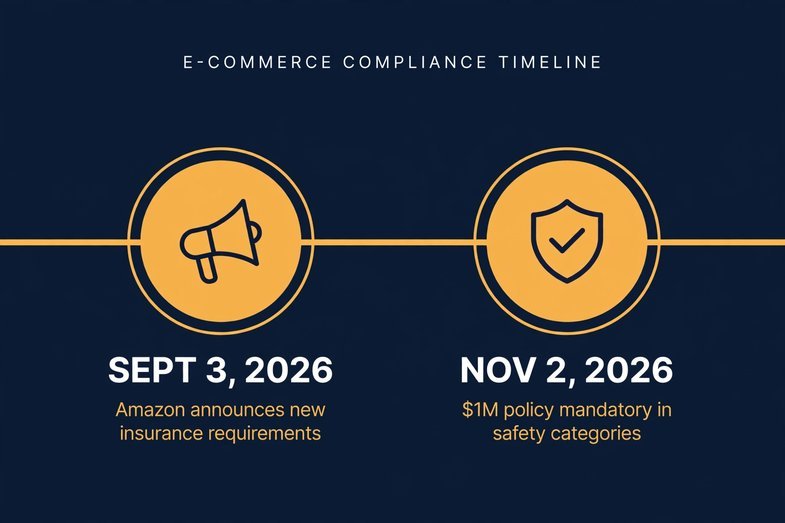
September 3, Amazon dropped a post in the US Seller Forums titled “New Commercial Liability Insurance Requirements effective November 2, 2026.” Nobody reads forum announcements for fun, so here is the translation.
First, the big one. If any of your ASINs sit in a category with enhanced safety listing requirements, you now need a policy with $1 million per occurrence and $1 million in the aggregate, covering those products, regardless of sales. Amazon’s phrase was “regardless of your gross sales proceeds,” which is corporate speak for “even at zero.”
And this is not just for new listings. Your existing ones are in scope too.
Second change, and this one is narrower: sellers based in Mainland China have to buy their new policies through the Amazon Insurance Accelerator starting November 2. If they already submitted a compliant policy before that date, it stays good until it expires. After that, it is the Accelerator or nothing.
What is NOT changing, because I have already seen this misreported twice: the $1 million limits are not new. The $10,000 trigger still applies to every other category. And if you are not in China, you can still buy from whatever insurer you want, as long as the policy meets Amazon’s standards.
Which Categories Are We Talking About?
Amazon names children’s products, cosmetics and ingestibles, and lithium battery products as examples. Then adds the classic “not limited to those.” Helpful, right?
The complete list sits behind a Seller Central login, so anyone handing you a “definitive” list in a blog post is guessing. Third-party seller guides have been counting about eleven since early September: fire-related goods, mattresses and sleep products, personal safety equipment, small kitchen appliances, home medical devices, tires, water and marine safety gear, that neighborhood. I would treat those counts as estimates, not gospel.
Honestly? Your Account Health page and the Business Insurance page in Seller Central are the only sources that matter here. Go look at which of YOUR asins are inside the perimeter. Do not take my word for it. Do not take any blog’s word for it.
And here is why this lands on an ungating blog: insurance just became part of the price of admission. Amazon’s ungating requirements for 2026 already ask for invoices, compliance documents, and test reports in safety categories. Now add a $1 million policy to that checklist. Difference is, an invoice is a one-time thing. This bill comes back every year.
What If You Just Do Nothing?
Amazon emails you. You get 45 days to submit proof. Miss it, and your listings in the safety categories go dark until you upload a compliant policy.
Here is the part people keep getting wrong, so let me be blunt: ONLY those listings go dark. Your other categories keep selling like nothing happened. But if your whole catalog is toys? Or supplements? Forty-five days to find a policy, get underwritten, and upload a certificate is tighter than it sounds. Ask anyone who has tried to rush commercial underwriting.
What the Policy Actually Has to Cover
$1 million per occurrence. $1 million aggregate. Covering the products you list in the affected categories. That is the part Amazon says out loud.
The full criteria list lives on Amazon’s Commercial Liability Insurance Requirements page. Have your broker confirm your certificate hits every line before you upload it. A rejected certificate does not just cost you the resubmission. It costs you days. And days are the one thing you do not have right now.
Okay, But What Does It Cost?
Straight answer: I cannot quote you a number. Nobody writing a blog post can, and you should distrust anyone who tries.
Third-party guides are floating $400 to $1,200 a year for small sellers. Those are estimates from other sellers and brokers, not Amazon’s numbers. Your actual premium depends on your products, your claims history, your revenue. All the boring stuff.
What I CAN show you is how the math changes. Picture this: you sell a $25 kids’ night light, 30 units a month. Under the old rules, you stayed under $10,000 a month and never thought about insurance. After November 2, that insurance bill shows up whether you sell 30 units or 3. Fixed cost. For thin-margin listings in safety categories, it can swallow the whole profit.
Some sellers are going to look at that math and walk away from certain categories. That is not quitting, that is arithmetic. Better to do it in October with a clear head than in December staring at deactivated listings.
Getting Compliant Before November 2
Do not wait. Underwriting takes real time, and half the sellers in these categories are about to shop for policies at the same time. You know how that goes.
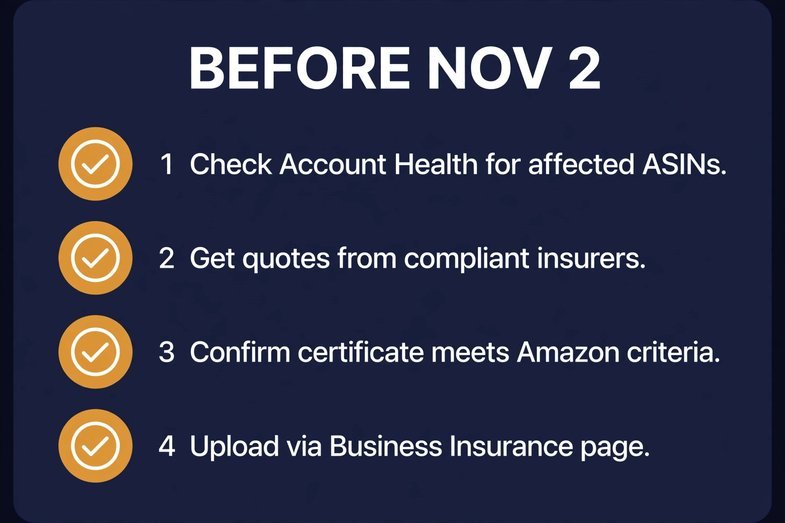
First, check your exposure. Account Health, Business Insurance page, Seller Central. Figure out which ASINs are actually in the blast radius before you spend a dollar.
Then get quotes. If you are US-based, any insurer works as long as the policy meets Amazon’s standards. The Amazon Insurance Accelerator, the panel Amazon built with the broker Marsh, is one option. Its policies are pre-checked against Amazon’s requirements, which takes the rejected-certificate risk off the table. Still optional for non-China sellers, same as before.
Before you upload anything, have your insurer confirm the certificate meets every criterion on Amazon’s requirements page. Limits, covered products, all of it.
Then upload it through the Business Insurance page and keep the thing active. A lapsed policy drops you straight back into that 45-day window.
One more thing. If you are mid-ungating in one of these categories right now, budget the insurance into your plan today. An authorized wholesale supplier gets you compliant invoices, and that matters, but invoices do not cover liability. You need both pieces.
The Bottom Line
This rule does not kill wholesale in safety categories. It raises the cover charge.
If you were already doing real volume, past $10,000 a month, you were probably buying this insurance anyway. Nothing changes for you except the paperwork deadline. The sellers who feel this are the small and new ones. The exact sellers the old threshold was protecting. Funny how that works.
Selling in these categories, or working toward ungating in them? Treat November 2 as a wall, not a suggestion. Get the policy. Upload the certificate. Keep selling.
Need help getting your account and catalog compliant? SupplyCore USA works with wholesale sellers on ungating, supplier verification, and the compliance paperwork Amazon actually asks for. Book a free consultation and we will map out exactly what your categories require before the deadline.
Do I need the $1 million policy if I sell less than $10,000 a month?
After November 2, 2026, yes, if any of your listings are in an enhanced safety category. Outside those categories, the $10,000-in-a-month trigger still applies.
Does the rule apply to listings that are already live?
Yes. Amazon says the change applies to both new and existing listings.
Can I buy the policy from any insurer?
If you are not based in Mainland China, yes, any insurer whose policy meets Amazon’s criteria. China-based sellers must use the Amazon Insurance Accelerator for new policies starting November 2.
What happens if I do not submit proof of insurance?
Amazon emails you with a 45-day window. After that, your listings in the enhanced safety categories can be deactivated until you submit a compliant policy.
Is the Amazon Insurance Accelerator mandatory?
Only for new policies from Mainland China-based sellers, starting November 2, 2026. For everyone else it remains one optional route among others.