
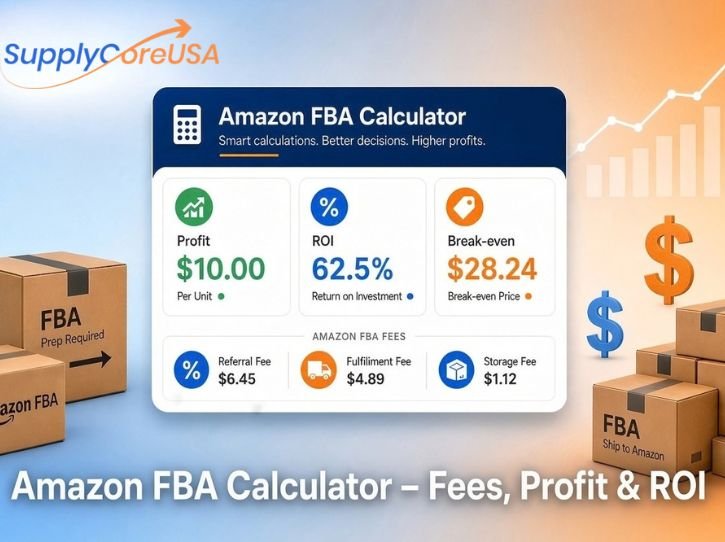
An Amazon FBA calculator shows what Amazon will charge on a product and what you’ll actually keep after fees. Run it before you buy inventory, not after. Most sellers don’t lose money on bad products. They lose it on products that looked fine until the fees showed up. Amazon raised average FBA fees by $0.08 per unit in 2026, then added a 3.5% fuel and logistics surcharge on April 17. Tiny numbers. Stack them across a few hundred units and they sting.
At SupplyCore USA, we supply wholesale inventory to Amazon FBA and Walmart resellers, so we see the same pattern every week. Buyers who check the math first order smaller, smarter, and more often. Buyers who skip it tend to come back with a pallet they can’t move.
What Is an Amazon FBA Calculator?
It’s a free or paid tool that takes a product’s ASIN, your selling price, and your unit cost, then estimates Amazon’s fees and your net profit.
Think of it as a quick reality check. You enter the ASIN, the price you plan to charge, and what your supplier wants per unit. The tool pulls Amazon’s fee data and hands back a profit number.
Why not just do the math in your head? Because Amazon never charges a single fee. Referral, fulfillment, storage, and placement charges all land on the same unit, and it’s easy to forget one. A calculator catches them all, so you compare products on net profit instead of a hunch.
How Does an FBA Calculator Work?
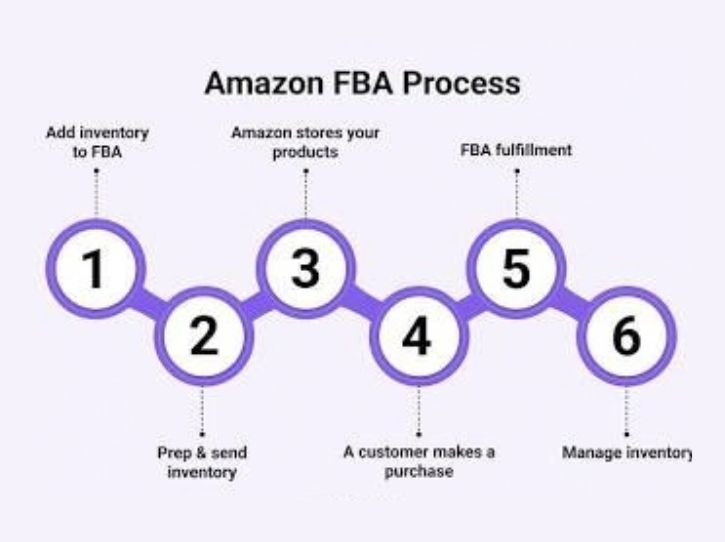
The calculator reads the product’s category, size, and weight from its ASIN, applies Amazon’s fee schedule, and subtracts your costs from your price. Start with the ASIN, the 10-character code in any Amazon listing URL. Get one character wrong and you’re pricing a different product. Copy it straight from the page, then confirm the brand, title, and pack size match what your supplier ships.
Next comes your landed cost. That’s unit price plus inbound freight, labels, and prep labor. People forget prep constantly. Don’t, especially since Amazon ended its own prep services in 2026.
Last, read the results. Look at profit per unit first, then margin, then ROI.
What Fees Does an FBA Calculator Include?
A solid calculator covers the referral fee, FBA fulfillment fee, monthly storage fee, and inbound placement fee. The best ones also include the 2026 fuel surcharge.
Here’s how each one behaves in practice.
| Fee | What drives it | Typical 2026 figure |
| Referral fee | Category and selling price | 15% for most categories, $0.30 minimum |
| Fulfillment fee | Size tier and shipping weight | Varies, plus 3.5% surcharge |
| Storage fee | Cubic feet and season | Higher from October to December |
| Placement fee | Size tier and split choice | $0.14 to $1.90 per standard unit on minimal splits |
Category matters more than most beginners expect. Referral rates run anywhere from 8% to 45%, so a product can look great in one category and mediocre in another. Storage deserves a warning. Inventory that sits around roughly 271 days or more picks up aged-inventory surcharges. A slow seller doesn’t just tie up cash; it quietly pays rent too.
Peak season adds a layer as well. Holiday fulfillment charges run about $0.32 higher per unit from October 15 through January 14. If you sell gifts, price for that window separately.
How to Calculate Amazon FBA Profit
Net profit equals your selling price minus product cost, Amazon fees, and other selling costs.
Net Profit = Selling Price − Product Cost − Amazon Fees − Prep and Shipping
Let’s use a $40 product. The referral fee takes $6.00. Fulfillment and other Amazon fees take another $8.00. Product cost is $12 and prep is $4. You keep $10, a 25% margin.
| Line item | Amount |
| Selling price | $40.00 |
| Product cost | −$12.00 |
| Referral fee (15%) | −$6.00 |
| Fulfillment and other fees | −$8.00 |
| Prep and shipping | −$4.00 |
| Net profit | $10.00 |
One quick note on sales tax. Marketplace facilitator laws mean Amazon collects and remits it, so it doesn’t belong in this formula. Income tax on your profit is separate, and you’ll owe it, so set money aside.
How to Calculate Amazon FBA ROI
ROI equals net profit divided by your total investment, multiplied by 100.
ROI = Net Profit ÷ Total Investment × 100
In the example above, your investment is $12 product cost plus $4 prep, so $16. Divide $10 by $16 and you get a return on investment of 62.5%.
Why does this matter more than raw profit? Because $10 earned on $16 beats $10 earned on $60 by a mile. ROI shows how hard each inventory dollar works.
Count only cash you spend before the sale: unit cost, inbound freight, prep. Fees Amazon deducts afterward come out of revenue. Plenty of sellers set a personal floor, often around 30%, and pass on anything below it.
How to Find the Amazon FBA Break-Even Price
Your break-even price is the lowest price at which you cover every cost. Divide fixed costs by one minus the referral rate.
Break-Even Price = Fixed Costs ÷ (1 − Referral Rate)
Here’s the part beginners miss. The referral fee grows as your price grows, so simply adding up costs understates the floor. Using the same product, fixed costs are $24: $12 for the product, $4 for prep, and $8 for fulfillment and other fees. Divide $24 by 0.85 and you get about $28.24. Drop below that and every sale loses money.
Keep this number handy when competitors start undercutting. It tells you exactly where to stop.
Amazon FBA Calculator for Wholesale Products
For wholesale, enter your supplier’s case-pack unit cost, check profit per unit, then multiply by the quantity you plan to order.
Bulk pricing changes the math. Your unit cost falls as quantities rise, so rerun the Amazon FBA calculator at each price tier before choosing an order size. A twelve-unit case multiplies profit by twelve. It multiplies mistakes by twelve too. A $2 error per unit becomes $240 across ten cases.
Compare supplier quotes on landed cost, not sticker price. Freight, minimums, and payment terms can flip the winner.
Paperwork matters here as well. Buyers who resell tax-free usually give suppliers a resale certificate, and Amazon may ask for supplier invoices during brand approval. Keep every one. It’s dull work that protects your account.
Retail and online arbitrage work the same way, with one difference. Store purchases carry sales tax and clearance deals dry up quickly. Wholesale gives you repeatable supply and tiered pricing, which is why many resellers start with arbitrage and move to wholesale as they grow.
FBA vs FBM: Which Fulfillment Method Is More Profitable?
FBA usually wins on small, fast-moving products. FBM usually wins on bulky, slow, or low-margin items.
With FBA, Amazon stores, packs, and ships. You pay fulfillment and storage fees, and you get the Prime badge. With FBM you handle every box and every customer email yourself. You pay postage, packaging, and your own time instead.
Neither is automatically cheaper, so run both in the calculator using identical product data. Compact items that sell quickly tend to favor FBA because Prime lifts conversion. Oversized or slow movers favor FBM because storage fees keep ticking. The referral fee is the same either way, so it won’t decide the question.
How Accurate Is an Amazon FBA Calculator?
An Amazon FBA calculator is only as accurate as the data you feed it and the date of its fee tables.
Garbage in, garbage out. You need the ASIN, selling price, unit cost, dimensions, weight, category, and your shipping and prep costs. Amazon updated its rate card on January 15, 2026 and added the surcharge on April 17. A tool that missed either update will flatter your profit.
Then there’s what calculators leave out: advertising, return losses, aged-inventory surcharges, and income tax. Knock roughly 10% off your expected profit as a safety cushion before you buy.
Once your first settlement report arrives, compare it with your forecast. Fix any gaps in your actual costs, and your next estimate gets sharper.
Amazon FBA Calculator FAQs
Is there a free Amazon FBA calculator?
Yes. Amazon’s revenue calculator in Seller Central is free, and several third-party tools offer free plans. Run the same product through two of them. If the numbers disagree, check the dimensions first.
How are Amazon FBA fees calculated?
Amazon adds a referral fee, a size-based fulfillment fee, monthly storage, and any placement charge to each unit. Category sets the referral rate. Size and weight set fulfillment. Cubic feet drive storage.
Can an FBA calculator calculate profit?
Yes. It subtracts product cost, Amazon fees, and other expenses from your selling price. Treat the result as a first filter. Ads, returns, and taxes usually sit outside the estimate.
How do I calculate Amazon FBA ROI?
Divide net profit by total investment, then multiply by 100. Count product cost, inbound shipping, and prep. A $10 profit on a $16 investment gives 62.5%.
What is the difference between FBA and FBM fees?
FBA charges fulfillment and storage fees. FBM makes you pay shipping and labor yourself. Both pay the same referral fee, so compare per-unit totals for your specific product.
Can I use an FBA calculator for wholesale products?
Yes. Enter your wholesale unit cost and the ASIN to see profit and ROI per unit and per case. Check brand approval before you buy. A restricted listing can block sales even when the margin looks perfect.
Book a Wholesale Strategy Call With SupplyCore USA
You can book a wholesale consultation with SupplyCore USA to review margins, supplier pricing, and order sizes for Amazon FBA and Walmart.
Numbers look different when someone checks them with you. Bring your ASIN shortlist, your minimum margin, and your monthly buying budget. We’ll match supplier pricing and case packs to your profit goals, so every order has a number behind it.