
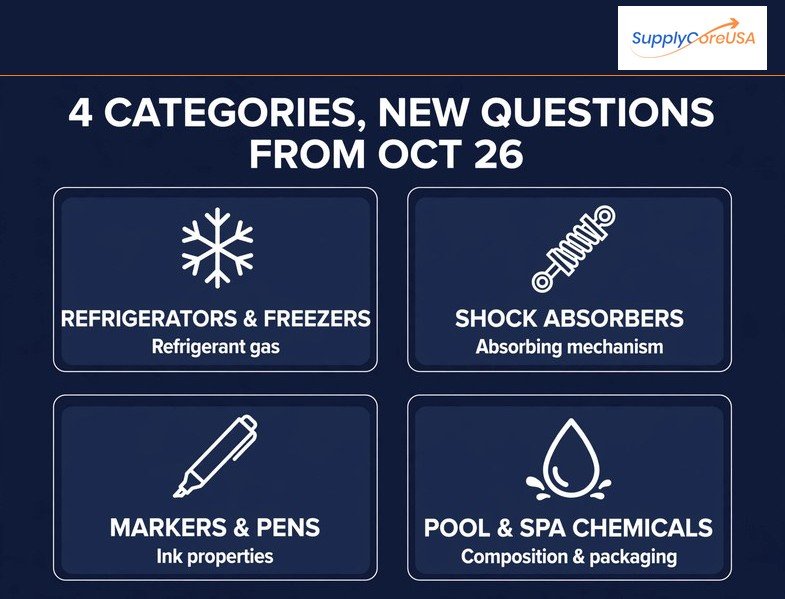
Starting October 26, 2026, Amazon adds new dangerous-goods questions to the listing process for four categories: refrigerators and freezers, shock absorbers, markers and pens, and pool and spa chemicals. Create a listing or edit an old one in these categories, and you answer the questions first. No answers, no live listing. Simple as that.
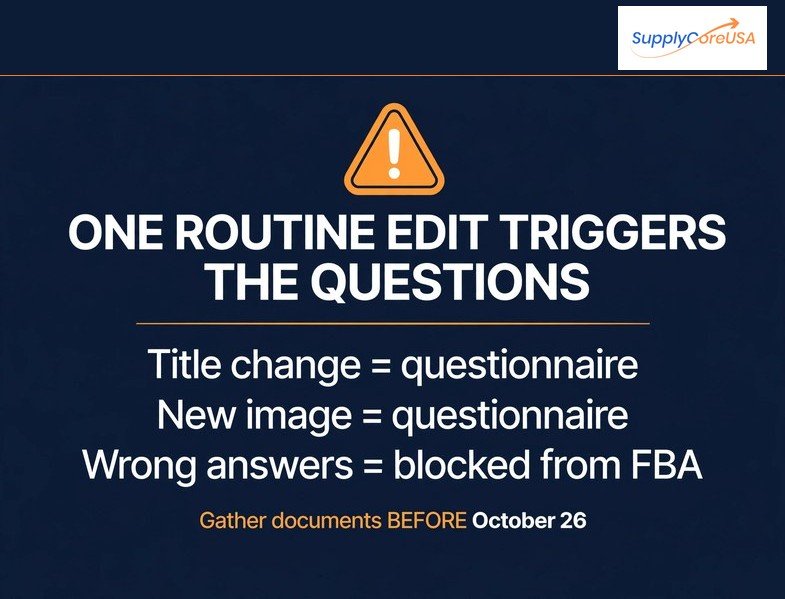
And yeah, edits count. I keep repeating this because it is the part that will blindside people. You fix a typo in a title on November 3rd and suddenly Amazon wants to know about your ink chemistry.
Look, I have been through enough of these Amazon compliance rollouts to know the pattern. There are always two groups. Group one hears about it the morning their listing gets flagged and spends the week in panic mode. Group two had their documents ready early and barely notices. Two weeks out, you get to choose your group.
So What Actually Changes on October 26?
Amazon drops a new set of dangerous-goods (hazmat) questions into the listing workflow. New listing or edited listing in the four affected categories, you answer before it goes live.
Does this mean your products are now “hazmat”? Not necessarily. Amazon’s stated reason is pretty reasonable on paper: better product info means they can actually tell what is dangerous and what is not, then store and ship it properly. Supposedly this also unlocks more shipping options and cuts down on surprise disposal fees.
Reasonable on paper. In practice it is one more hoop, and this hoop demands exact answers. Your manufacturer specs, not your marketing copy.
The Four Categories (and the Questions Nobody Asked For)
Refrigerators, air conditioners, freezers. This one is oddly specific. Sellers who have seen the questions say Amazon asks whether the unit ships pre-charged with refrigerant, which refrigerant, the code (R-32, R-290, that sort of thing), and the amount by volume and by mass in grams. Where do you find that? Nameplate on the unit, the manual, or the spec sheet. Do not have it? Email your manufacturer today. These replies take days.
Shock absorbers and suspension lift supports. Questions about how the shock-absorbing mechanism works. Auto parts sellers, this is your lane.
Markers and writing instruments. Ink properties. I can already hear you: markers? Really? Yeah, really. Inks can carry regulated chemicals. Amazon wants it spelled out.
Pool and spa water-treatment products. Chemical composition and packaging. Chlorine, algaecide, pH stuff, all of it.
If you wholesale in any of these, stop reading and go export your ASIN list. I will wait. (Not really. But do it today.)
The November Trap
Here is how this actually bites people. Your marker listing has run fine for a year. Early November, you refresh the title and main image for the holiday rush. Save. Boom, ink questionnaire. You do not have the ink specs, so you guess at a couple of fields.
Bad move. Wrong or conflicting hazmat info can land your inventory stuck in a dangerous-goods review or blocked from FBA entirely. And in Q4 that is not an inconvenience, that is your best sales weeks evaporating.
My rule, and I would tattoo it on every seller dashboard if I could: do not touch an affected ASIN until your paperwork is done. Not the title. Not the bullets. Not the image. Paperwork first.
Get This Ready Before October 26
For every ASIN in those four categories:
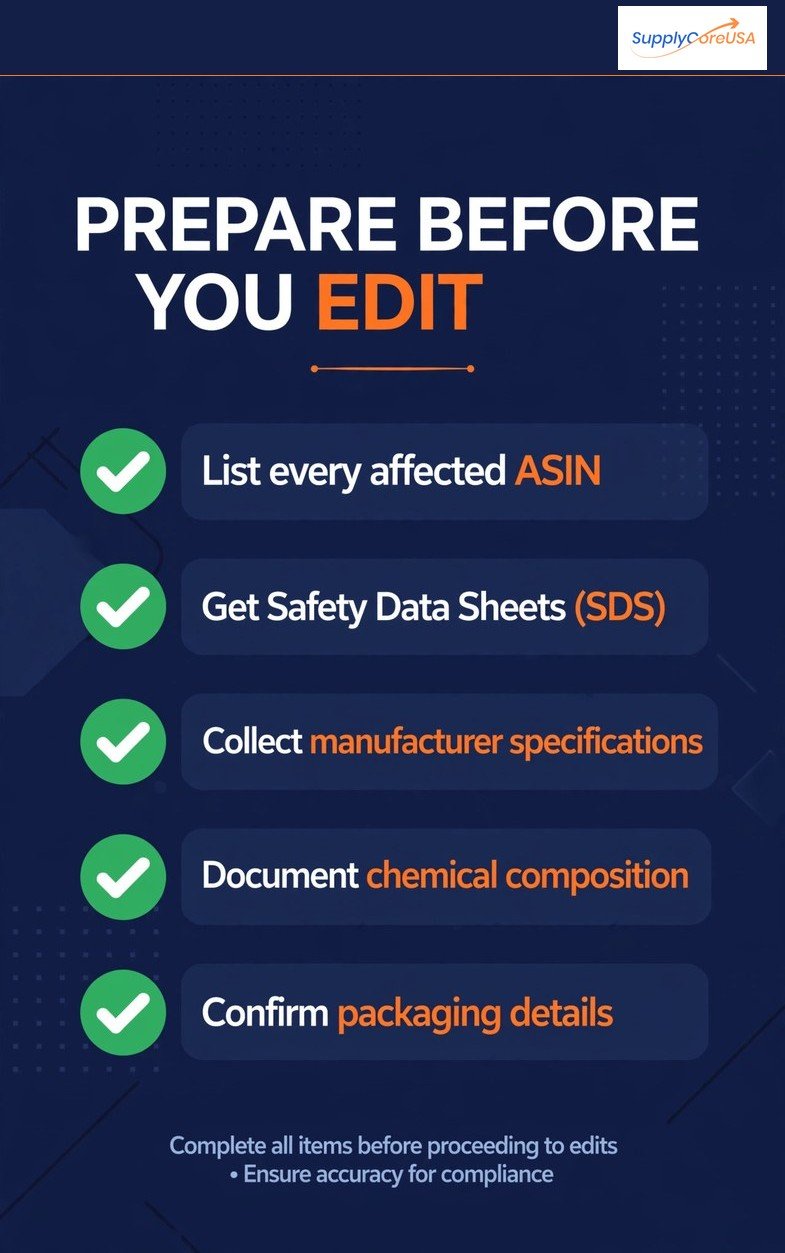
- Export the full list from Seller Central. Your memory will miss one. It always does.
- Real specs from the manufacturer. Not your listing copy, the actual spec sheet.
- Manufacturer name and contact info.
- Safety Data Sheet wherever one exists. Pool chemicals should have one already. If yours does not, request it now. Suppliers are slow.
- Chemical composition for anything with a formula. Inks, treatments, all of it.
- Packaging details. Amazon asks outright for pool and spa products.
- Refrigerant info: type, code, volume, grams. Nameplate or spec sheet.
And please, do not copy-paste one answer across every ASIN. I know it is tempting when you have forty of them. But identical answers on different products is exactly the “conflicting information” that triggers reviews. Each product gets its own truthful answers.
Wholesale sellers, one more thing. Your distributor should be handing you most of this without a fight. If they cannot produce an SDS or real specs for a chemical product, that is a red flag about the supplier, full stop. We only work with distributors who keep proper documentation, which is why our sellers do not get ambushed by things like this: see how we source.
Not in These Categories? Lucky You.
This rollout skips you entirely. But file the lesson anyway, because Amazon is not done. The FBA prep shutdown and the November insurance rule ran the exact same playbook this year: deadline announced, sellers scramble, prepared ones cruise through. Compliance is a year-round habit on Amazon now.
This Week’s To-Do List
Today: export ASINs, flag the four categories.
This week: chase down every missing SDS and spec sheet.
Before Oct 26: finished answers saved per product, somewhere your team can find them.
After Oct 26: answer carefully, product by product. Never guess.
If you are not sure your products are in scope, or your supplier’s paperwork looks thin, talk to us before the deadline. October 25 stress is optional. November 15 with a blocked listing is expensive.
FAQs
What is the hazmat issue in Amazon?
Amazon screens products that could be risky to store or ship. For FBA, listings must pass a dangerous-goods review first. Sloppy or missing info means delays, extra fees, or removal.
What does Amazon consider hazardous materials?
Batteries, aerosols, flammable liquids, corrosives, strong magnets, and everyday-looking stuff like perfume and hand sanitizer. The Safety Data Sheet is what Amazon actually trusts.
How to apply for the Amazon hazmat program?
Seller Central, then Settings, then Fulfillment by Amazon, then Dangerous Goods. Submit the application and wait for review. Note it is per product, not a blanket approval.
How many classes of DG are there on Amazon?
Amazon does not publish a numbered list for sellers. The global standard is 9 UN hazard classes. Honestly the number does not matter for you. Accurate product data and a valid SDS do.
How to get hazmat certification for shipping?
Amazon does not issue one. What you need: Dangerous Goods program enrollment where required, a valid SDS per product, and DOT/UN-compliant packaging and labels. Anyone physically handling hazmat shipments needs proper DOT hazmat training.